
Client Access
Amazon DSP is hard to judge from campaign stats alone. Amazon Marketing Cloud (AMC) shows what happens between a shopper's first ad and their purchase, and you can now use it without writing SQL.
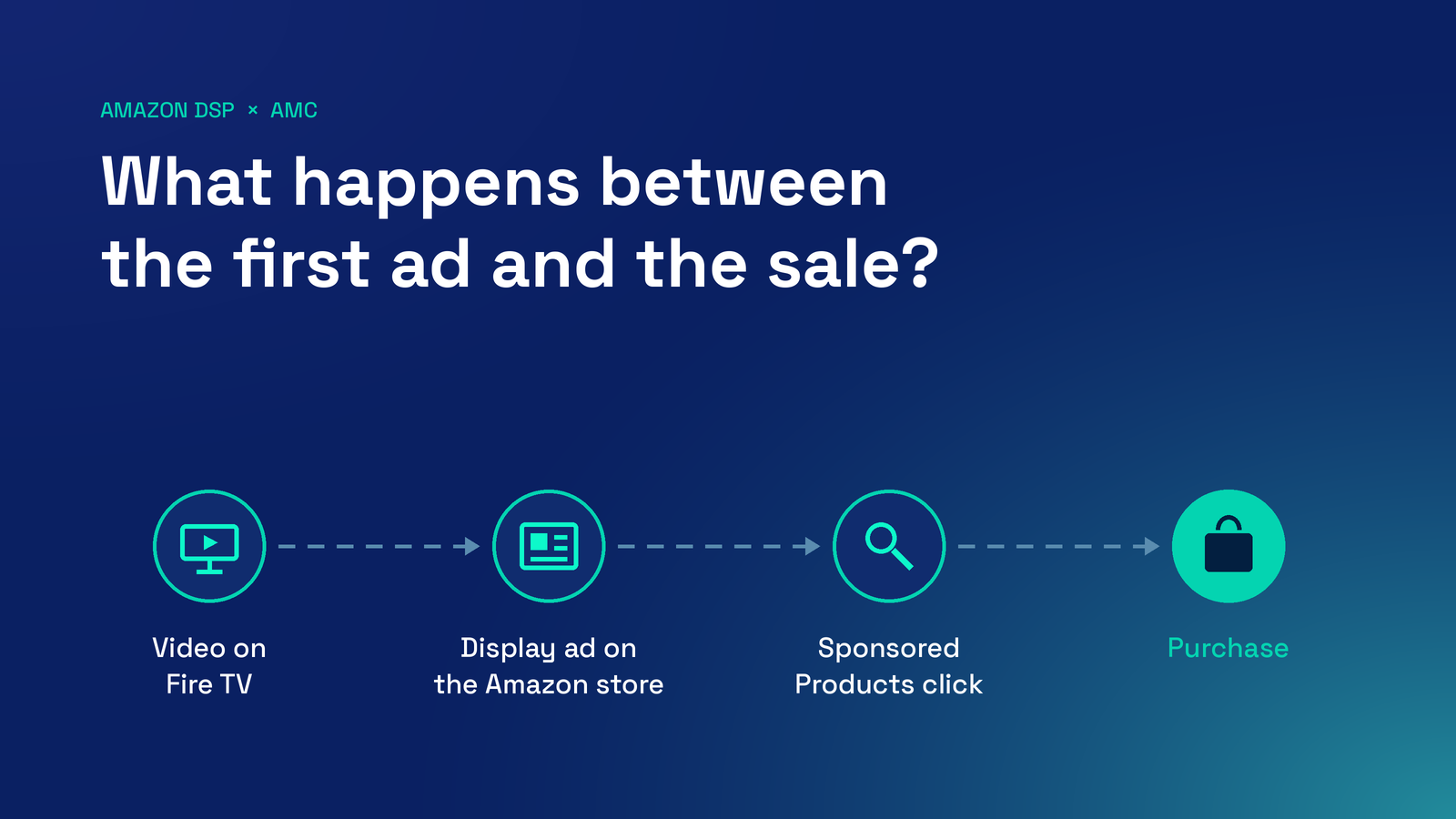
DSP ads often play their part long before the purchase. A shopper sees a video on Fire TV, a display ad on the Amazon store a few days later, then searches for your product and clicks a Sponsored Products ad. Which ad did the work?
Standard stats struggle with that question, for three reasons:
That is the gap AMC fills.
Amazon Marketing Cloud is Amazon's clean room for advertising data. It links ad exposures and purchases at the shopper level, across DSP and Sponsored Ads, in anonymised form. That makes it the place to answer journey questions: how often a shopper saw your ad, how long they took to buy, and what else they saw first.
The catch is access. AMC is queried in SQL, results only come back above Amazon's privacy thresholds, and each question needs its own query. For most advertisers, that means relying on an analyst, or not using AMC at all.
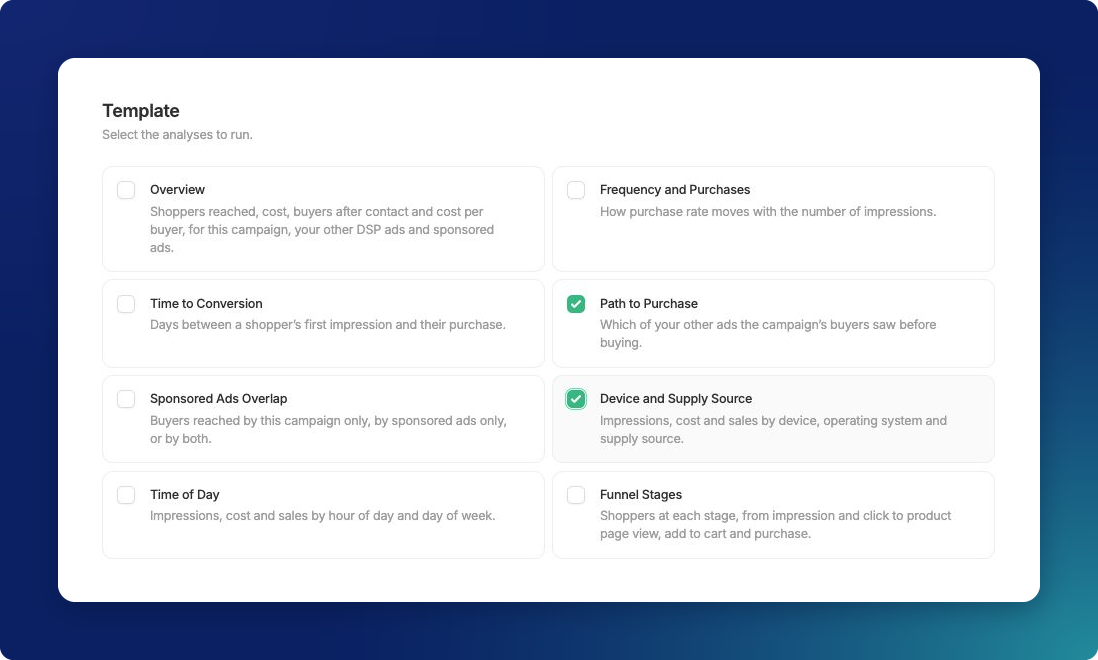
Each question below matches one analysis in m19's DSP Strategy Analysis. For each one: what it shows and how to read it.
What it shows: for this DSP strategy, your other DSP campaigns and your Sponsored Ads, the shoppers reached, the cost, the shoppers who bought after their first contact, and the cost per purchaser.
How to read it: a first look at the role each group plays. Groups overlap, since one shopper can be reached by several, so the rows don't add up.
What it shows: how many shoppers reached each stage: saw the ad, clicked it, viewed a product page, added to cart, bought.
How to read it: the biggest drop tells you where the journey breaks. A shopper can reach a later stage without an earlier one, for instance buying after seeing the ad without clicking it.
What it shows: shoppers grouped by how many times they saw your ad (1, 2 to 3, 4 to 7, 8 or more), with the purchase rate, cost and ROAS of each group. A buyer's impressions are counted up to their first purchase.
How to read it: look for the point where the purchase rate stops rising while the cost keeps climbing.
What it shows: purchases by delay after the ad: same day, 1 to 3 days, 4 to 7 days, 8 to 14 days, split between new-to-brand and repeat buyers.
How to read it: the more purchases come days later, the more a campaign judged in its first days is undercounted.
What it shows: the order in which shoppers first met this strategy, your other DSP campaigns and your Sponsored Ads, with the purchase rate of each path. A Sponsored Ads touch here is a click.
How to read it: paths starting with DSP suggest the strategy opens journeys; paths ending with it suggest it closes them.
What it shows: shoppers reached by this DSP strategy only, by Sponsored Ads only, or by both, with their cost and purchase rate. Each shopper counts in one row only.
How to read it: a large DSP-only group means the strategy reaches shoppers your search ads don't. A large overlap means it mostly reaches shoppers who already search for you.
What it shows: impressions, cost, CPM, product page views, purchases and ROAS by device, operating system and supply source, and by hour of day and day of week.
How to read it: compare each surface's share of impressions with its share of sales. Hours are in the advertiser's time zone.
These analyses describe your audience. They don't measure incremental sales.
Shoppers who see your ads differ from those who don't, before any ad is served. A retargeting strategy reaches people who already viewed your products, so their purchase rate would be higher even without the ad. Read a high purchase rate as a sign of who you reach, not as proof that the ad caused the sale.
Two more things to keep in mind:
m19 now runs all seven analyses for you. With DSP Strategy Analysis, you pick a strategy and a period, and m19 queries AMC and returns the answers in a ready-to-read file. No SQL, no analyst. It's available on m19 Professional.
1. Go to AMC > DSP Strategy Analysis and click New analysis.
2. Choose the type: Single strategy, to see how one DSP strategy reaches shoppers and drives purchases, or Multi-strategy, to see how several DSP and Sponsored Ads strategies lead shoppers to buy together.
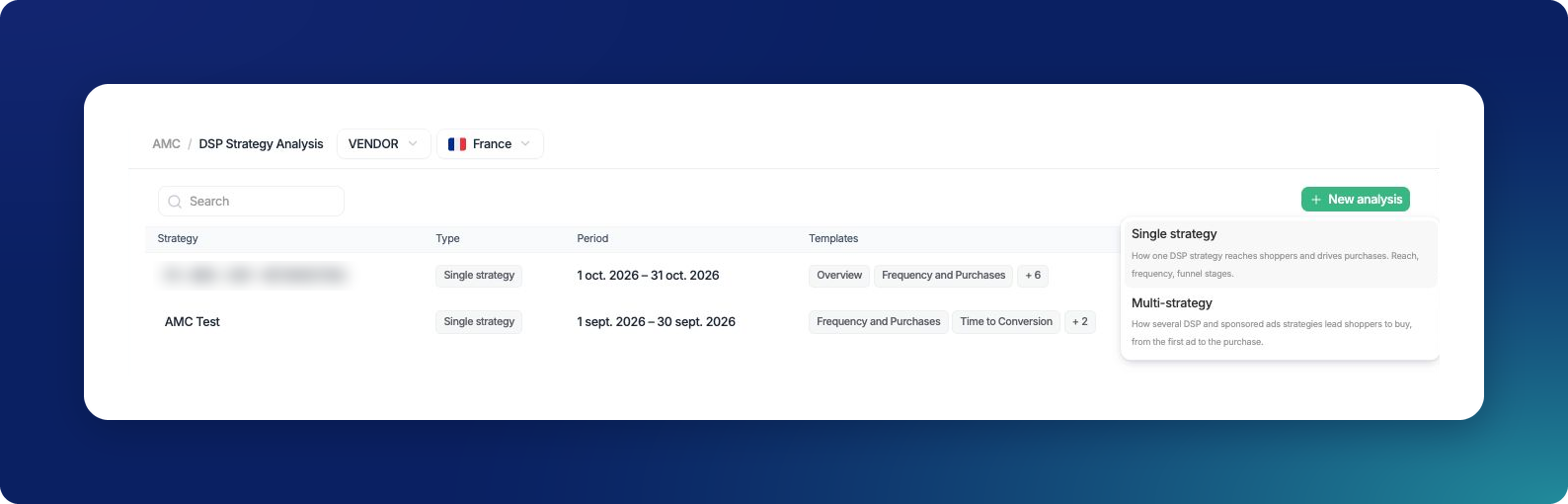
3. Pick the strategy, the period and the analyses you want to run.
4. When the results are ready, download them as an Excel file, with one tab per analysis and notes on how each number is counted.
To get complete numbers, pick a period that ended at least 14 days ago.
Do I need to know SQL to use AMC?
Not with DSP Strategy Analysis in m19. You pick a strategy, a period and the questions you want answered, and m19 runs the AMC queries.
Why is my DSP ACOS different from my Sponsored Products ACOS?
DSP credits a sale after a view of the ad, not only after a click, and DSP sales are not always deduplicated against Sponsored Ads sales. The two ACOS are not comparable, which is why journey analyses like these help.
What is the Anonymised Data row?
It groups shoppers that AMC hides because the group is too small to report, for privacy reasons. Their totals are kept, but they can't be broken down further.
Can these analyses prove that my DSP ads caused sales?
No. They describe the audience your ads reach and how it behaves. Measuring incremental sales requires a test with an unexposed control group.
Is DSP Strategy Analysis available on Autopilot?
No. DSP and AMC features are part of m19 Professional.
Stay up to date and accelerate your business with tips and the latest Amazon news.

Lorem ipsum dolor sit amet, consectetur adipiscing elit. Suspendisse varius enim in eros elementum tristique. Duis cursus, mi quis viverra ornare, eros dolor interdum nulla, ut commodo diam libero vitae erat. Aenean faucibus nibh et justo cursus id rutrum lorem imperdiet. Nunc ut sem vitae risus tristique posuere.
Lorem ipsum dolor sit amet, consectetur adipiscing elit, sed do eiusmod tempor incididunt ut labore et dolore magna aliqua. Ut enim ad minim veniam, quis nostrud exercitation ullamco laboris nisi ut aliquip ex ea commodo consequat. Duis aute irure dolor in reprehenderit in voluptate velit esse cillum dolore eu fugiat nulla pariatur.
Block quote
Ordered list
Unordered list
Bold text
Emphasis
Superscript
Subscript
Stay up to date and accelerate your business with tips and the latest Amazon news.
m19 offers easy-to-use software and a dedicated service for you to manage your Amazon ads.
Grow your profit, save massive time, we are committed to helping you win on Amazon ads.
Stay up to date and accelerate your business with tips and the latest Amazon news.