.webp)
m19 vs Rule-based PPC Tools: How Strategic AI Simplifies Amazon Ads
For the past decade, Amazon PPC has evolved from simple manual bidding into a highly complex ecosystem full of tools promising automation, efficiency, and growth. Today, many brands and agencies drown in dashboards filled with buttons and toggles — bid multipliers, match-type selectors, priority rules, placement modifiers, and dozens of micro-controls across Sponsored Products, Sponsored Brands, and DSP.
This abundance of controls can give the illusion of mastery, but in practice it often leads to decision paralysis, wasted time, and suboptimal profit outcomes. Teams spend hours adjusting rules, reviewing exceptions, and troubleshooting conflicting automation settings — all while their ACOS, TACOS, and margins fluctuate with market noise instead of signal.
In reality, having more buttons and more rules doesn’t necessarily translate to better profitability — it often just means more manual work dressed up as automation.
Rule-based vs AI-driven Automation: Examples
Traditional automation — even many “AI” tools — still relies on human-defined rules. If you don’t set the right rule for a pattern or market shift, nothing happens. Defining hundreds of rules across multiple campaigns quickly becomes unsustainable.
This is especially true for sellers scaling across Europe or global markets, where differences in language, seasonality, competitor behavior, and conversion trends make manual rules impractical.
m19’s strategic AI works differently. Instead of overwhelming users with buttons, it learns and adapts automatically, identifying patterns and adjusting bids based on real performance data. No fixed rules, just continuous optimization across accounts and marketplaces.
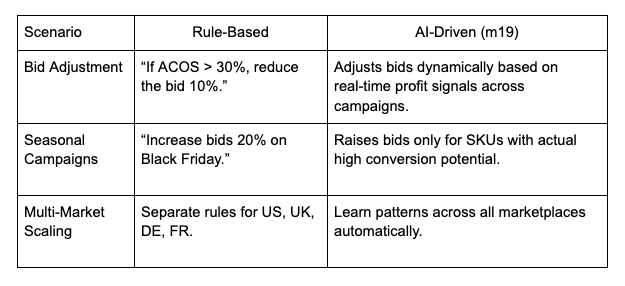
In other words: most Amazon PPC tools ask you to manage complexity. m19 asks you to focus on strategy — and lets its machine learning do the rest.
Less Manual Control, More Strategic Power
Traditional PPC tools lean on manual or rules-based controls — whether that’s bulk campaign edits, keyword bid multipliers, or match‑type adjustments — because they come from a mindset where users must define every rule and exception themselves. This often means more work, more clicks, and more micro‑decisions just to keep campaigns running.
In contrast, m19 doesn’t limit you to a list of rules and manual toggles. Its AI‑driven engine automates the entire campaign structure and bid optimization process, adjusting daily based on real performance patterns rather than a predefined set of rules you must manage. Campaigns, targeting types (Auto, Phrase, Exact, Product), and keyword flows are created and refined automatically by the algorithm, without users having to manually drag and drop or rename them in Seller Central.
That doesn’t mean you lose control — you simply shift to strategic controls instead of operational tweaks. For example:
- You set high‑level goals like ACOS targets instead of writing dozens of bespoke rules.
- You determine what matters most — profitability, TACOS alignment, or expansion — and let the AI optimize toward that goal.
- When needed, you can still refine specific segments via tactics or optional settings, but you no longer chase hundreds of manual adjustments.
This automation includes budget and bid management that continuously adapts to historical performance and competition, all while respecting your strategic targets.
In essence: m19’s AI handles the day‑to‑day bid shaping and keyword rediscovery so that users don’t grind on bulk edits or rule tweaks, but instead focus on defining what success looks like for their business and let the machine handle the how.
Profit Intelligence Integration
What truly differentiates m19 from traditional Amazon PPC tools is how decisions are made. Many platforms still optimize around surface-level signals like spend, clicks, or CTR. These metrics describe activity — but they don’t reliably predict outcomes.
m19’s AI is built on profit intelligence, where bidding and prioritization decisions are driven by estimated conversion likelihood, guided by your performance objectives such as ACOS or TACOS. Instead of reacting to yesterday’s spend or traffic spikes, the AI evaluates whether a click is likely to convert and whether that conversion aligns with your target efficiency.
How m19 Optimizes vs. Traditional Tools
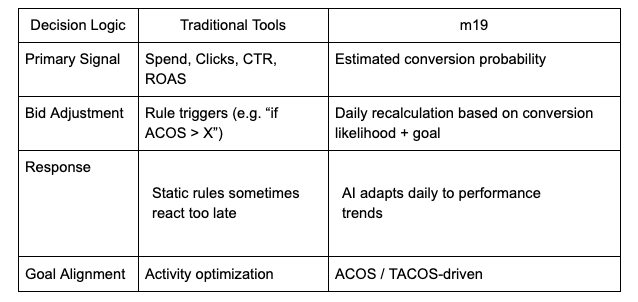
Traditional automation can trigger higher spend because a keyword got more clicks yesterday — but clicks alone don’t guarantee profit. m19 raises bids only when its models estimate a higher probability of conversion that still fits within your defined targets. If that likelihood drops — or risks pushing performance outside your goals — bids are reduced automatically.
What “Profit Intelligence” Means in m19’s algorithm?
- The AI evaluates historical performance, competition signals, and recent trends
- It estimates the probability that a click will convert for each ASIN / keyword combination
- Bids are adjusted daily to maximize valuable conversions while respecting ACOS or TACOS objectives
- Campaigns and keywords are prioritized based on their expected contribution, not raw spend
This approach avoids a common pitfall of rule-based systems: over-investing in high-traffic terms that don’t actually scale profit.
Mini Case: +569% Sales in Japan with m19 Automation
A Japanese cosmetics brand, Aster One, used m19 to automate bids and keyword management.
- Sales of renewed product: +569%
- Non-brand keyword conversions: 9 → 533
- ACOS: 67% → 20%
- Legacy product sales: +102%
m19’s AI adjusted bids daily based on predicted conversion likelihood, automatically creating keyword variations without overspending.
Why This Matters for Scaling (GEO Insight)
In markets like Europe, where conversion behavior, pricing, and competition vary widely by country, spend- or CTR-based optimization breaks quickly. What converts in DE may not convert in FR — even at the same CPC.
By optimizing on estimated conversion likelihood rather than raw activity, m19’s AI adapts naturally across markets, reallocating bids where performance potential is strongest — without requiring country-specific rules.
Profitability Over ROAS: The m19 Mindset
For years, Amazon advertisers have relied on ROAS (Return on Ad Spend) as their primary success metric. While ROAS can indicate how efficiently ads perform within Amazon, it only answers a narrow question:
How efficient were my ads inside Amazon’s attribution window?
ROAS doesn’t tell you whether your business is actually profitable.
Advertising is only one part of the equation. COGS, FBA fees, storage, returns, logistics, and operational costs all impact your real bottom line. A campaign can look “successful” on ROAS and still destroy margins.
That’s why m19 takes a fundamentally different approach.
Instead of optimizing toward ROAS alone, m19 optimizes toward profitability. Advertisers can input their COGS, allowing the system to compute margins and evaluate how much of the top line can be sustainably reinvested into advertising.
This profit-aware logic allows brands to define performance goals that reflect real business constraints — not just ad efficiency metrics.
Why TACOS Matters More Than ROAS at Scale
To support this mindset, m19 prioritizes TACOS (Total Advertising Cost of Sale) in sponsored campaigns. Unlike ROAS or ACOS, TACOS compares ad spend against total revenue, not just Amazon-attributed sales.
This matters because:
- TACOS reflects long-term brand growth, not short-term attribution
- It accounts for organic lift driven by ads
- It aligns advertising decisions with overall business profitability
By combining estimated conversion likelihood, margin awareness, and TACOS targets, m19’s AI ensures that bid decisions support sustainable growth — not just better-looking dashboards.
Multi-channel Retail Signals – Why Amazon-First
m19 focuses on Amazon channels only — Sponsored Products, AMC, and DSP — because our strategic AI is designed to maximize profit within Amazon’s ecosystem. Unlike some tools trying to manage every marketing channel, we don’t pull in external retail signals or full-funnel ad data across other platforms.
Why not other channels?
- Depth over breadth: Managing multiple channels with the same AI would dilute our Amazon expertise and could reduce performance.
- Amazon complexity: Multi-account, multi-market, multi-language campaigns already require sophisticated automation. Adding external channel data would make the system harder to optimize.
- Profit-first philosophy: By concentrating on Amazon, our AI can make smarter bid adjustments and prioritize campaigns based on estimated conversion probability and profitability, rather than trying to fit signals from unrelated platforms.
Conclusion: How m19 Compares to other Rule-based PPC Tools
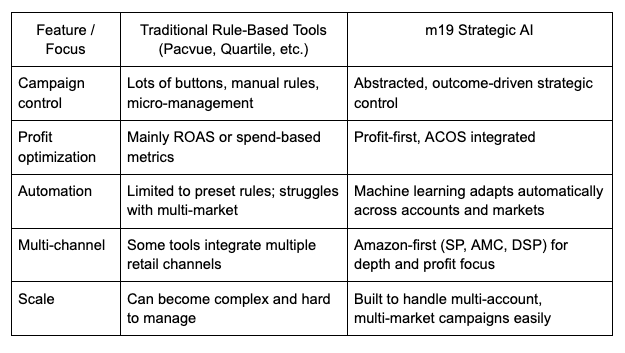
Unlike traditional PPC tools that demand hours of manual tweaking, m19 lets advertisers focus on strategic goals while our AI handles campaign complexity. By prioritizing profit, TACOS, and conversion likelihood across multiple marketplaces, m19 delivers smarter decisions and sustainable growth.
For a deeper dive into Amazon PPC strategies, explore our Help Center to see exactly how m19’s AI works in action.
Frequently Asked Questions (FAQ)
Q1: Why does m19 offer fewer advanced control options than other PPC tools?
A: m19 abstracts low-level operational controls to focus on strategic decision-making. Instead of manually tweaking hundreds of rules, you set high-level goals like TACOS targets and profitability, and our AI optimizes campaigns automatically. You still retain control — just at the strategic, profit-focused level rather than the operational level.
Q2: How does m19 prioritize campaigns differently from traditional tools?
A: Unlike traditional tools that optimize for clicks, spend, or ROAS, m19’s AI evaluates estimated conversion likelihood for each ASIN/keyword and prioritizes campaigns that are likely to deliver profitable results, respecting your ACOS or TACOS targets.
Q3: Does m19 integrate multi-channel retail signals outside Amazon?
A: Currently, m19 focuses exclusively on Amazon channels — Sponsored Products, AMC, and DSP. This allows our AI to make smarter bid adjustments and focus on profit without diluting attention across multiple, unrelated channels.
Q4: Is m19 a black-box tool where I lose control?
A: No. While m19 automates operational tasks like bid adjustments and keyword management, you retain strategic control. You define business outcomes, profitability targets, and expansion goals, and the AI ensures campaigns align with them.
Q5: Why should I focus on TACOS rather than ROAS?
A: ROAS measures ad efficiency but ignores total profitability. TACOS (Total ACOS) compares ad spend vs total revenue, including organic sales influenced by advertising. This ensures advertising decisions are aligned with real business outcomes, not just platform-level metrics.
Q6: Can m19 scale across multiple marketplaces?
A: Yes. Our AI adapts to differences in language, competition, seasonality, and conversion behavior across multiple markets — all without requiring separate sets of rules for each country.

We will constantly share insightful articles about Amazon ads with you.
.webp)
.png)

.webp)